
IAP2 Public Participation Spectrum
The IAP2 Public Participation Spectrum is a globally recognised tool and method to guide the level of participation and influence that the public could play in the stakeholder engagement for and decision-making on government strategies, policies and projects.
IAP2’s Public Participation Spectrum is designed to assist with the selection of the level of participation that defines the public’s role in any community engagement program. The Spectrum shows that differing levels of participation are legitimate depending on the goals, time frames, resources and levels of concern in the decision to be made. However, and most importantly, the Spectrum sets out the promise being made to the public at each participation level. The Spectrum is widely used and is quoted in most community engagement manuals. https://www.iap2.org.au/resources/spectrum/.
But, as Max Hardy says here, even the term ‘empower’ in the IAP2 context is about delegated decision making; it does not align with the community development concept of empowerment, nor that of most placemakers. It’s not about action or self-empowerment.
In short, there hasn't been a tool relevant for placemaking and in particular, outlining who is ‘doing’ what and ‘making it happen’.
The Placemaking Participation Spectrum
The Placemaking Participation Spectrum explores and explains placemaking roles and participation. It is similar to IAP2’s Spectrum, but instead relates to action and placemaking, rather than engagement and decision-making.
The spectrum is a continuum, or something that changes in character gradually, without any clear dividing points, according to the Cambridge Dictionary.
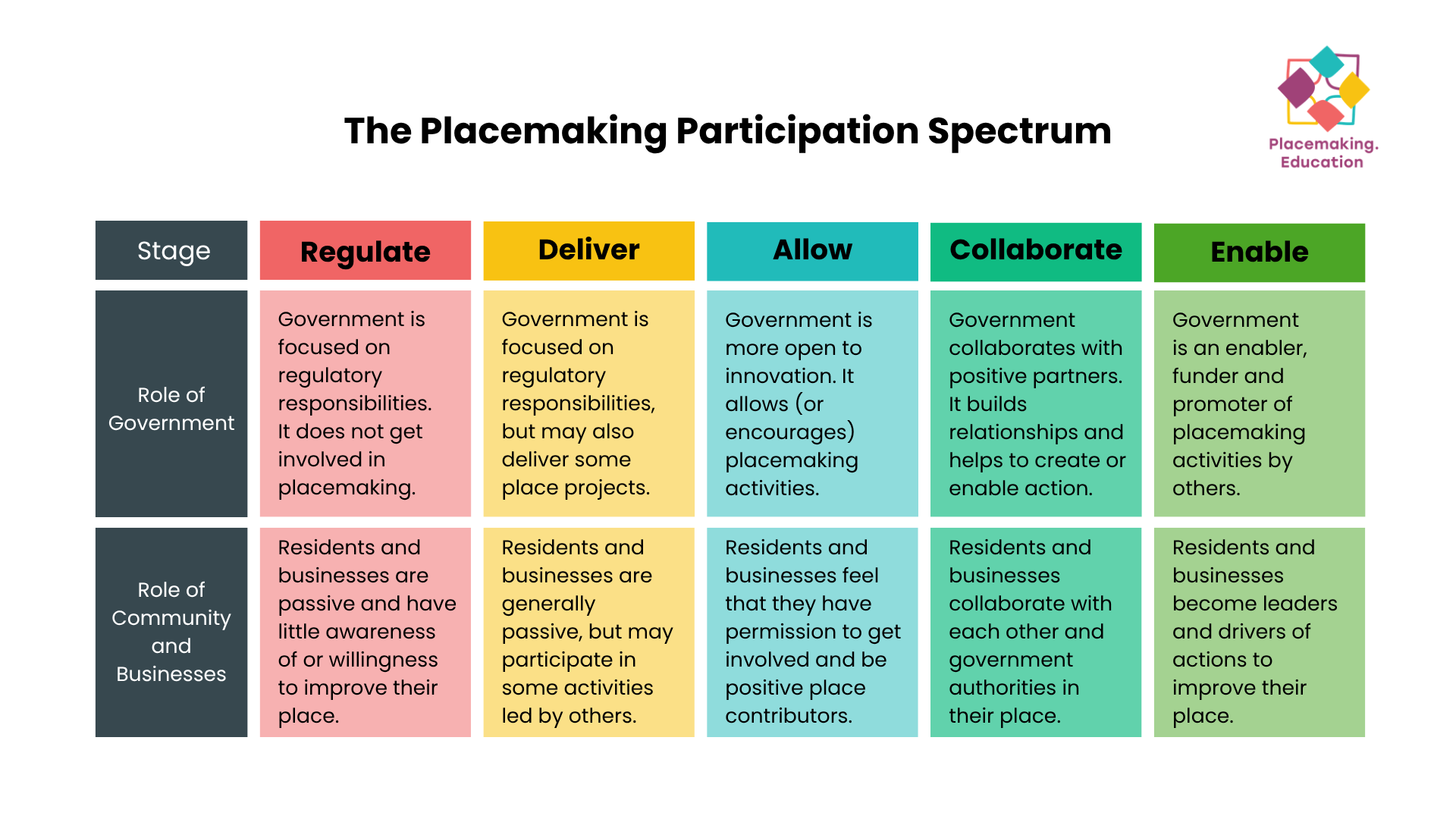
There are 5 stages on the spectrum.
Regulate
Governments in the Regulate stage are focused on their statutory and regulatory roles – things like managing roads, rubbish removal, building control, caring for parks, managing recreation centres, libraries, environmental health, managing community assets and lots more. Placemaking in this stage is sporadic at best, and often non-existent.
Local governments are tasked by State and Federal Governments and their communities with so many things, it is no wonder why they find it difficult to emerge from the Regulate stage.
Potential habits of thinking in government
"Service provision, regulating and administering are our main roles. Everything else is a distraction."
There isn't much hope for place improvement with this kind of thinking.
Implications for the local government
- Places will either decline slowly or quickly, depending on circumstances.
- At some point, the cry will emerge for the local government to "do something about ...". A knee-jerk response might then emerge. Reactive approaches usually struggle to create positive change.
- It creates apathy, cynicism and distrust because the community has little perceived agency nor influence.
- Hope for the area slowly dissipates like a morning mist. Once hope is gone, it is extremely difficult to change.
Implications for the roles of civil society and community
Residents and businesses are passive and have little awareness of or willingness to improve the place. Their habit of thinking is: "It’s the government’s job to make our place better."
This is the default business as usual, so there will be many examples of this situation.
Deliver
Governments in the Deliver Stage begin to realise that places are important. They might upgrade the hardware of places or manage events. The community is generally passive in this stage, but might ask for more if they like what they see done by professionals.
Habit of thinking in government
"Placemaking is just another service we deliver for our community."
Implications for the local government
- It is generally more expensive for both governments and ratepayers, because the local government needs to do all the work and has all the expectations placed on it
- It takes more time and resources.
- Seems to raise expectations ever-higher for what governments can and should do
Implications for the role of civil society and community
Because the local government is involved in placemaking, residents and businesses are generally still passive. They might attend an event, a business might start asking about parklets or extended street trading and some new ideas might emerge, inspired by things happening elsewhere. On the whole, businesses and residents are consumers of place rather than active contributors.
They might think: "That's nice. I wish they would do more ... here."
It builds dependency rather than resilience because local governments bear all the responsibility for delivery and action, rather than building the capacity and confidence of others to act.
It also treats people as customers of services rather than citizens with agency and skills. Doing for the community can lead to opinionated customers of your government's services.
Allow
In the Allow stage, government is more open to creativity and new ideas. It starts to let go of control. It allows (or leads) placemaking trials and activities.
Habit of thinking in government
"We have worked out what we want to see more of and now we are making that easier to do."
Implications for the local government
Andy Sharp states it beautifully when he talks about managing places to life, instead of (over)managing them to death. It can actually mean less work (for example fewer development applications, fewer issues), for better results.
Allowing changes helps people to move beyond "the ratepayer mindset" towards getting involved and creating better outcomes, once the see the potential opportunities. Don't just assume people will see the opportunities though. Your job is to help explain and promote it.
Allowing things to happen can help the community to overcome the unrealistic and unreasonable expectations are being placed on the local government to "fix everything".
Implications for the role of civil society and community
Residents and businesses are encouraged to step up and allowed to be positive placemaking contributors.
Their habit of thinking could shift to: "I didn’t realise I was able to do something. I want to give it go."
Some examples of this approach are:
- As of right alfresco dining and street trading permits for local businesses that meet certain requirements. The Midcoast Council in New South Wales is providing an example of this with its Vibrant Spaces program.
- Verge gardens are encouraged on nature strips
- Local governments make small-scale events super easy, including cover pesky things like insurance within certain parameters
- A 7 Day Makeover
Collaborate
Things start to get interesting in the Collaborate stage. Government works with positive partners to improve places. It could be a Town Team, a business association, community group or even a community enterprise. Like all good relationships, the partners can start to identify who can do what do improve the place in the short, medium and long-term. It focuses on building long-term relationships and enabling innovation and action.
Habit of thinking in government
"Working with partners and collaborators sometimes takes longer, but we can achieve a lot more!"
Implications for the local government
- can be less expensive as other people and organisations become more responsible for projects, actions or services
- takes more time upfront as connections, relationships and trust need to be built upfront, but It can save governments time, resources and money over time as it empowers the community to take on responsibility and actions
- it mitigates the expectations for what governments can and should do, particularly as the culture of the place starts to shift from "It's the government's job to fix X" to "How can we make this happen?".
Implications for the role of civil society and community
- residents, businesses and civil society groups become leaders and contributors for their place.
- it encourages the positive 'doers', the innovators and social entrepreneurs
- people start thinking: "We feel confident to be a positive changemakers. We want to do more."
- it encourages resilience because other actors can step up to be active contributors and supporters, meaning that the local government doesn't have to "do it all"
- it treats people as (potential) citizens with agency and skills to solve problems
Enable
Government is an enabler, funder and promoter of placemaking and residents and businesses become leaders and drivers of actions to improve their place.
Habit of thinking in government
We use all of our roles to help foster better outcomes: enabler, funder, service provider and advocate.
Implications for civil society and community
Community groups, and civil society lead the place vision and are the makers of better places and stronger communities.
Their habit of thinking is: "We feel empowered and responsible to help make our community better."
A living inspiration for many is Coin Street Community Builders on London’s South Bank.
Thirty years ago, the Coin Street area of London was bleak, unattractive, with few shops and restaurants. The residential community was dwindling and the local economy was weak. Today it is thriving mixed-use neighbourhood. It's a destination for millions of Londoners and visitors from overseas, with a thriving residential and business community benefiting from community facilities and services.
This change was led and championed by the local community. Coin Street’s activities are wide and far reaching. From giving families and children the best start in life through its childcare and family support, to creating and maintaining high quality live, work and play spaces on land which it owns.
Coin Street promotes enterprise, creativity and lifelong learning. Whether that’s through providing employment, volunteering opportunities, nurturing enterprise or delivering programmes and activities. It also provides housing that supports the local community, champions co-operative housing and influences local and national housing policy.