The Power of Stories
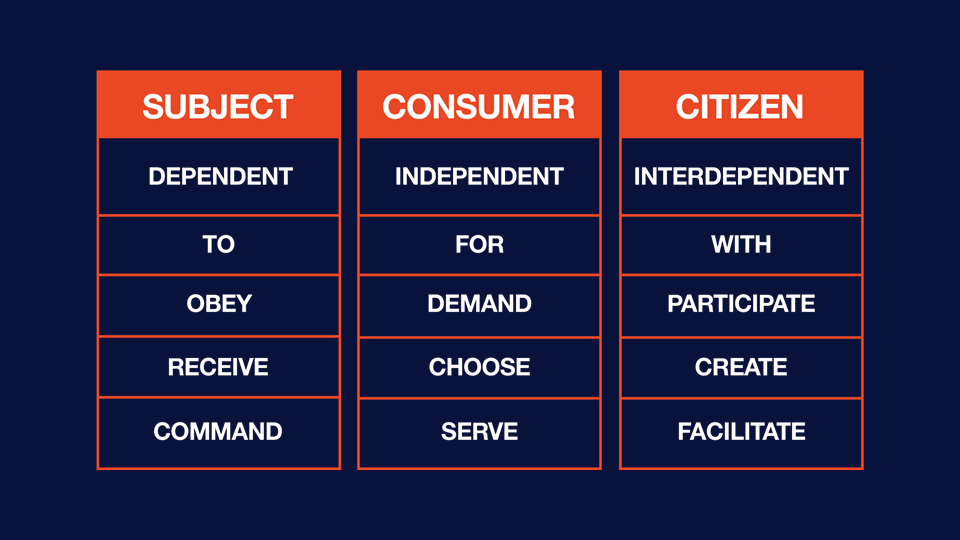
Humans are storytelling, and crucially, also story-dwelling creatures, says British author Jon Alexander in his book Citizens. We need stories to live by. To tell us who to collaborate with. What to create and who to care about. Alexander convincingly argues that the story we live by today — the story we are trapped in — is the Consumer Story.
The Consumer Story
This story positions the role of individuals as being to pursue self-interest, choosing the best option from those that are offered. It holds that the corresponding role of governments and leaders is to channel that self-interest and make it add up to the collective interest. It asserts that this will result in the best outcomes possible, because humans — Consumers — are inherently and inevitably self-interested.
The Consumer Story, amplified by media and advertising. subtly encourages us to outsource care and responsibility. When problems arise, the reflex is often: someone else should fix this. Government becomes the default problem-solver, and citizens become consumers.
The Consumer Story smothers the historical memories that there are other stories to live by. It causes people to lose their own agency and erodes their capacity to self-organise.
As civic participation has declined, governments and institutions have stepped in to fill the void. In doing so, they have unintentionally reinforced passive civic behaviours by positioning communities as recipients of services, rather than co-contributors to solutions.
This creates a self-reinforcing loop: reduced participation drives greater institutional control, which further erodes community capacity, confidence and initiative. As expectations of government have risen and they have taken on more and more responsibilities, trust in institutions and political leaders has paradoxically fallen. People feel frustrated, left out, and unheard.
The Subject Story
It’s tempting for disengaged and disempowered citizens to start looking for alternatives, which feeds political extremism. On the right we are seeing the rise of Fascism and Trumpism. On the left, we see charismatic leaders promising simple solutions to complex problems. Jon Alexander calls this the ‘Subject Story’. It suggests that a strong leader will protect and guide us. People should keep their heads down, and do as they are told, like an obedient subject.
Over time, top-down approaches further erode trust and confidence. Governments are continually attacked and criticised, often because of who is doing it (governments) and how they are doing (via top-down, non-participatory means), rather than purely what is happening.
Bureaucracies become even more risk averse, defensive, reactionary. Risk management processes, compliance and red tape increase, which add additional barriers to civic participation. Well-meaning regulations can fix a single issue, but often exacerbate these bigger risks.
The first part of our hypothesis is that top-down government approaches and passive civic behaviours are mutually reinforcing.
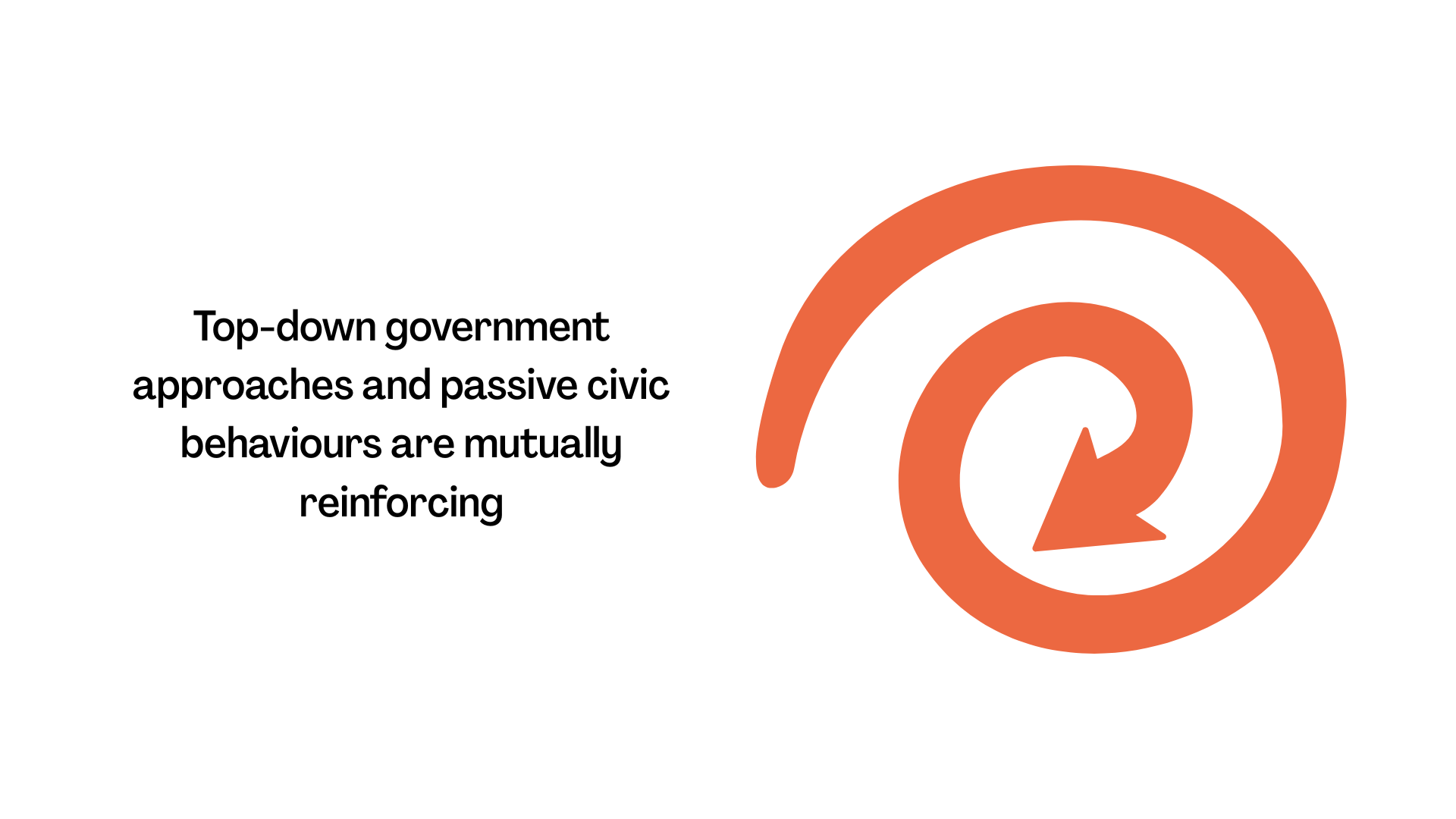
This negative spiral downwards is not sustainable in a democracy. It has significant political, financial and societal costs and feeds the frustration and anger in the community. Local initiatives are stifled or never even started as local action becomes ‘too hard’. That instinct is reinforced by the system itself. Navigating bureaucracy, securing approvals, managing risk and insurance — these are complex and time-consuming processes. For many, participation feels difficult, even futile.
The Citizen Story and the Democracy of Doing
As social, economic and environmental crises build in scale and intensity, we’re seeing a shift in people’s minds. The pendulum is shifting back towards the more positive and creative Citizen Story. This isn’t a new story; it’s a renaissance of the traditions of how communities have operated across many cultures for centuries.
Local people are the heroes of this story, contributing their ideas, energy and resources to shape better outcomes.
The second part of our hypothesis is that the solutions are also mutually reinforcing.
Governments that deliver essential services, as well as enable others to act, will help to facilitate the rise of active citizenship and the re-emergence of civil society as a positive force. We call this the ‘Democracy of Doing’.

The Democracy of Doing promotes the idea that democracy is based on a person’s relationship to the society around them, not just their relationship to governments and institutions. Democracy should be able to be lived every day, rather than being confined to the ballot box.
It moves beyond political representation and well-meaning consultation to co-production and collaborative action, where citizens and civil society groups are active participants in the planning, design, delivery, and management of their communities. To be effective, it relies on two essential ingredients: relationships and trust.
Research shows that relationships and trust are best developed by working on real projects together, which is why collaborative action is so important.
Western Australia is leading the way on this innovative approach. Here are two local examples of the Democracy of Doing in action:
- The Western Australian Government’s Streets Alive Program
- The Town Team approach, which emerged in and with the City of Vincent
1 – Streets Alive: Creating safer streets through community-based action
The road death toll continues to rise across Australia, despite the best efforts of and significant investments by Federal, State and local governments.
Reducing speed limits is one of the fastest, most effective and least expensive ways to save lives on our roads, Research shows that lower traffic speeds reduce crashes, improve health outcomes, increase neighbourhood amenity, boost social connections and are better for local businesses. Austroads has also released a report on the clear economic case for reducing speeds on urban streets.
But, reducing vehicle speeds often gets resisted by some in the community. Projects struggle to build the necessary local support due to a lack of understanding or a cynicism that reducing speed limits is just about raising revenue.
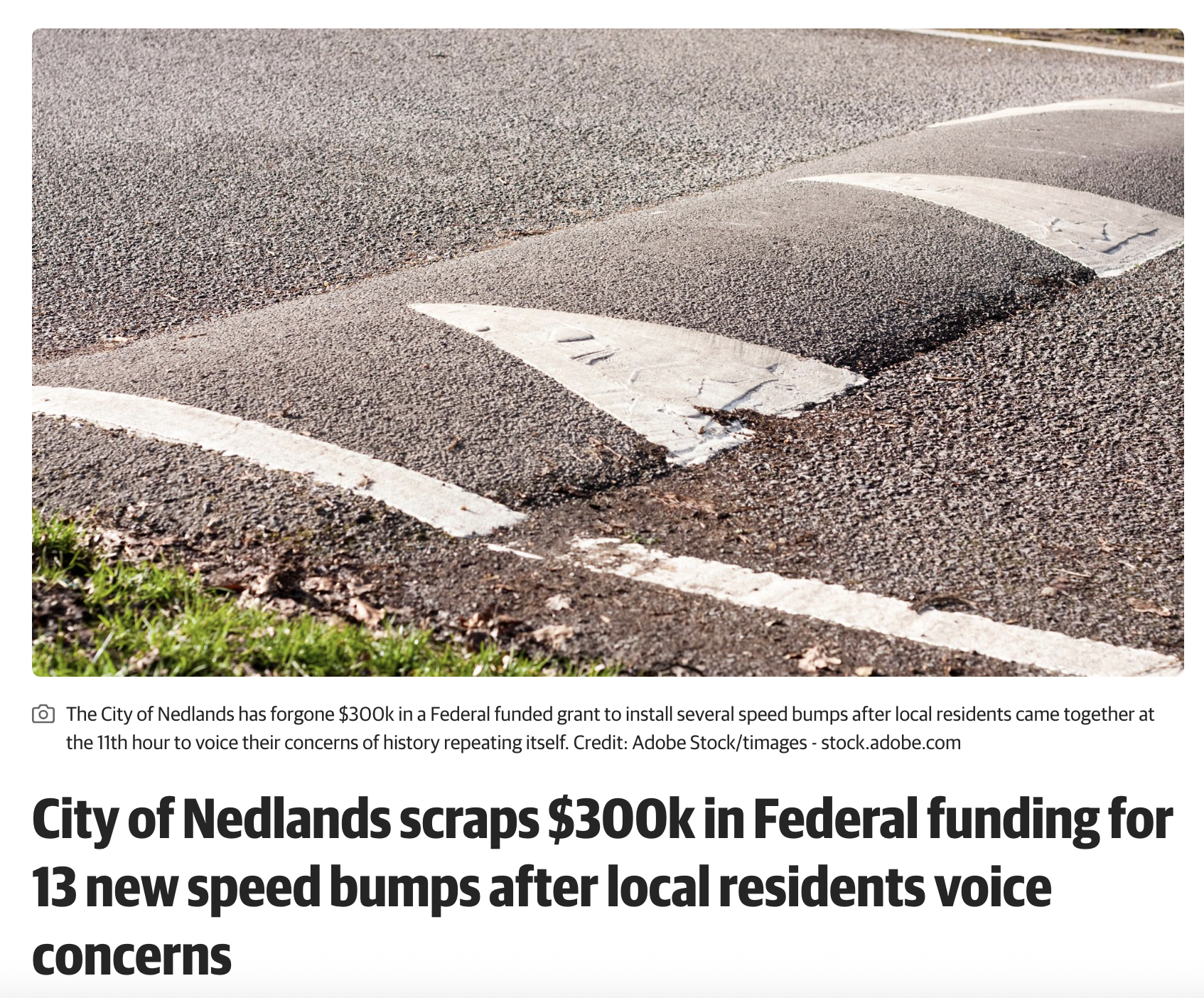
Excerpt from ‘Perth Now – Western Suburbs’ News Article
Other residents and businesses recognise the need for safety and amenity improvements, but have few avenues to act beyond lobbying their local authority.
The combined lack of community support, understanding, agency and trust makes it difficult for government decision-makers to make the necessary changes. So, the road toll continues to rise.
At a delivery level, local authorities need permission from Main Roads Western Australia, a State Government agency, for changes to local roads. Historically, it has adopted a risk-averse and traffic-movement-focused approach, and has been concerned about the potential of community backlash to speed reductions or traffic calming. Whilst this position is evolving, the combination of caution and regulatory rigidity has constrained the pace and scale of local safety improvements. Forward-thinking change is needed to improve road safety outcomes.
How does the Streets Alive Model work?
Streets Alive is a community-led funding and capacity building program delivered by non-profit social enterprise Doing Co, in partnership with Main Roads WA.
The program provides $5 million over 5 years (2023 – 2028), distributed through smaller seed grants of up to $10,000 and larger traffic calming intervention grants of up to $100,000. With an eye to long term sustainability, the program also provides ongoing capacity building to help local governments and communities deliver collaborative projects that slow traffic and make local roads safer, more vibrant and people-friendly.
The program is managed by Doing Co, in conjunction with an advisory committee that includes the WA Local Government Association, the Department of Transport and Major Infrastructure and Main Roads WA.
Streets Alive has four key objectives:
- Build local capability and capacity to deliver road safety initiatives
- Shift attitudes and behaviours towards safe speeds
- Improve the design and safety of local streets
- Trial a collaborative, scalable model of co-delivery between communities and local governments
The program responds to the need for community-driven solutions that reduce vehicle speeds, strengthen local involvement and improve safety outcomes.
“Local governments across WA are committed to creating safer, healthier and more liveable communities. Programs like Streets Alive play an essential role in empowering local residents, volunteers, town teams and councils to co-design safer public spaces. This program strengthens community ownership of road safety, builds local capability, and supports practical, low cost interventions that reduce speeds, shift behaviour and protect lives. Our members consistently report that community-led, place-based approaches to safety receive far greater buy- in and achieve more enduring change than top-down interventions.”
Stacey Hutt, CEO, LG Professionals WA
Streets Alive project staff provide tailored, practical project support and training in both the Perth metropolitan area and across regional WA. This includes:
- Coordinating support meetings between community members and local governments
- Site visits
- Training on how to collaborate, best practices and design guidance
- Helping people to navigate local government policies
- Providing relevant resources and online training
Streets Alive staff can help to manage issues, work through tensions and improve processes to help projects get implemented. They proactively help local governments to understand and utilise collaborative approaches.
Streets Alive Outcomes & Impact (so far)
Local governments have benefitted from strengthening existing, and forming new, collaborative relationships with their residents, local community groups, and business owners. They are equipped with new tools and models to help future community engagement processes.
Community groups are feeling more capable and confident in working with their local governments, particularly as bureaucratic barriers are being removed (or reduced). Trust and relationships are being developed.
The broader community has been more receptive to projects led by or that involve local people. The bottom-up approach reduces cynicism and potential mistrust of the motives of distant authorities. It helps to create a broader level of support and a deeper understanding of and appreciation for the value of slower and safer streets.
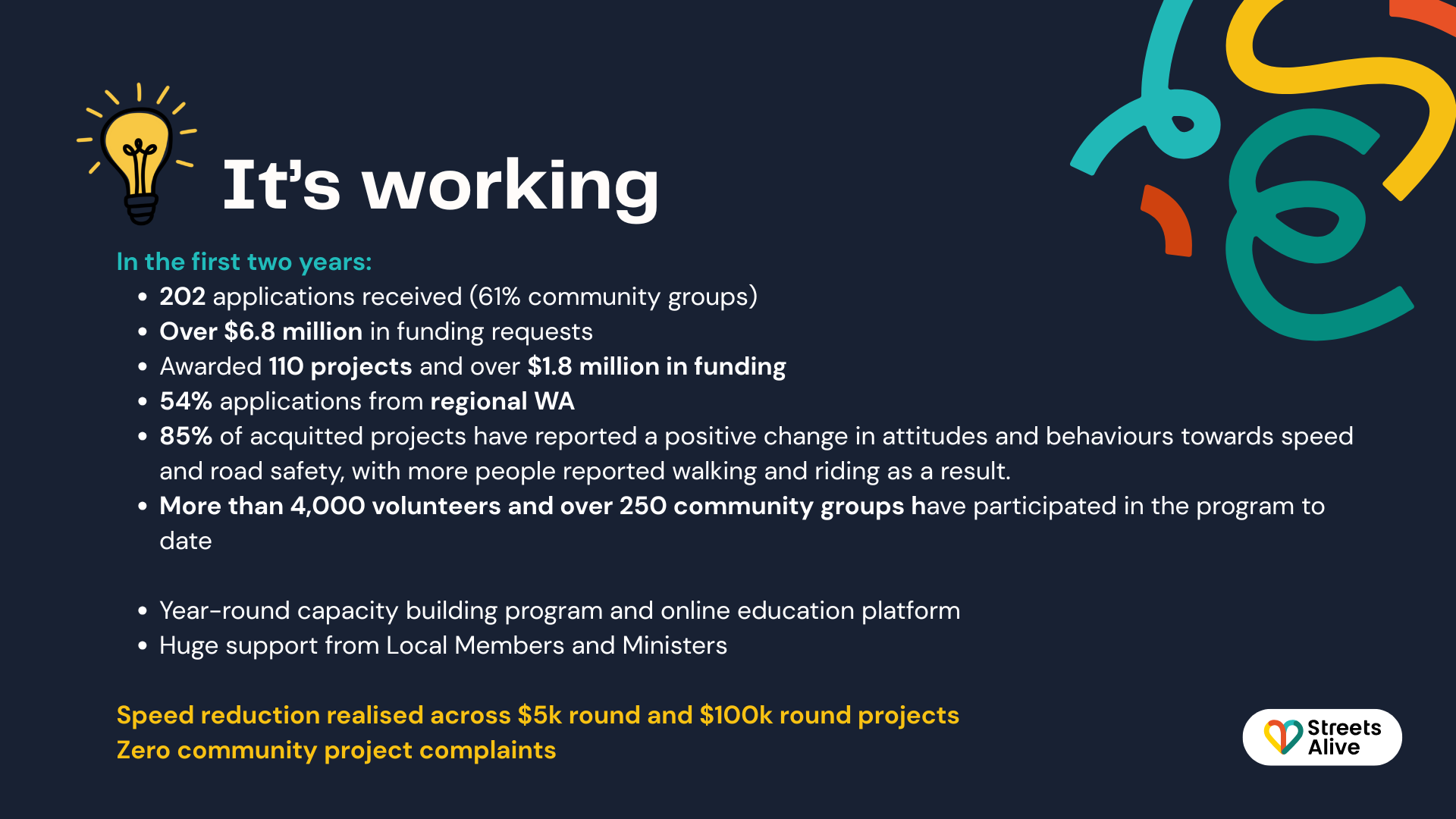
Most importantly, there are positive road safety results. To date, over 100 projects have been completed to advocate for and/or slow traffic. The evidence speaks for itself.
- Several speed limit reductions approved and implemented through Streets Alive projects, including 20km/h in central Fremantle; 40km/h school zone in Kardinya, 40km/h in the Brookton town centre; 40km/hour area wide in Joondalup
- Grant recipients have reported shifts in driver behaviour across 85% of project teams
- Approximately one-third of completed projects focused on school-precinct safety, a focus area for authorities and local schools
- 4,800 people have completed a Streets Alive road safety training and education program. 94% of applicants have rated the program support at least 4 out of 5, which is excellent
- More than 4,100 volunteers have been involved, and government authorities are becoming more experienced in co-design and co-delivery projects
- Over $1 million in additional government funding has been committed for road crossings and speed-limit changes as a result of the Streets Alive program
Mindsets and processes are shifting as a result of the program.
“In Vincent, we have seen first-hand how Streets Alive enables neighbourhoods to lead the conversation about safer speeds and more liveable streets. These projects don’t just install temporary (and permanent) treatments – they create advocates, lift community capability, and build long-term cultural change around how people move.”
City of Vincent Chief Executive Officer, David MacLennan
The program’s greatest challenge has been overwhelming demand. In the first two years, 202 grant applications sought $6.8 million from a funding pool of less than $1.8 million; only one in four projects could be supported. In response to this strong uptake and demonstrated impact, additional State Government funding has been sought for 2026–27.
Addressing road safety and safer speeds is a complex challenge and requires a multi-disciplinary approach, with support, trust and collaboration from all layers of government and the community.
Streets Alive, supported by state and local governments, provides the opportunity for communities to get involved with solving the complex, seemingly intractable challenge of road fatalities. Local people have made it clear that they really care and want to contribute to making their neighbourhoods, and by extension, all of us, safer.
These reflections from local ‘doers’ demonstrate the passion and commitment that Streets Alive unlocks.
“One of the most notable shifts has been the increased awareness of road safety issues. Residents, drivers, and pedestrians became more engaged with the idea that road safety is a shared responsibility.”
Cundarin Community Resource Centre
“The Monger Street Safety Initiative is more than just an infrastructure project; it represents a collaborative effort to improve public spaces, enhance safety, and foster a thriving community. By involving local governments, community groups, residents, and businesses in the planning, funding, and evaluation stages, the initiative ensures that the needs and desires of the community are at the heart of the project.”
Bencubbin Community Resource Centre
“The Miami Village Heart project demonstrated that place enrichment is only possible through collective efforts. By overcoming challenges together, the South Mandurah community created a safer, more vibrant precinct and established a lasting legacy of collaboration and pride. The mantra, “It takes a village,” perfectly captures the spirit of the project and its transformative impact.”
City of Mandurah, grant recipient
Streets Alive has put the ‘Democracy of Doing’ to the test. The outcomes and impact reporting data prove it works. The techniques used have built greater understanding, developed trust and improved relationships in and between both government authorities and local communities.
This approach can be replicated and applied to help address other large-scale, complex policy challenges.
2 – Town Teams: Local people and local governments working together
The City of Vincent was rated the second most liveable area in Australia in 2025. But 20 years ago, it was a very different story. The area’s town centres were struggling with a high number of shop vacancies, anti-social behaviour and a lack of civic pride. With no visible momentum for change, the community was disengaged.
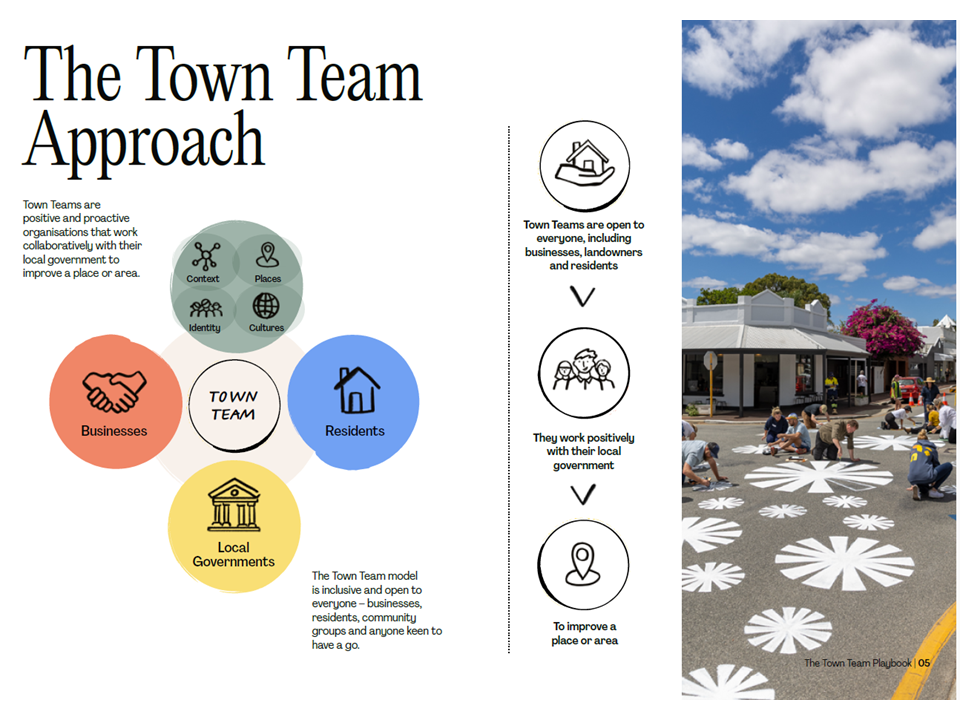
Beaufort Street in Highgate and Mount Lawley was one of those struggling town centres. In 2007, a local resident, John Carey saw the potential and ran in the local council election. He was unsuccessful, but undeterred. He called a meeting that drew around 50 local businesses and residents. Together, they identified immediate actions to revitalise the street, including shop window displays, public art and a street festival. They called themselves the Beaufort Street Network and became Australia’s first ‘Town Team’; a group of businesses and residents working positively and proactively to improve their place.
The Network built momentum and support. It completed dozens of actions to improve the precinct, including launching Australia’s first-ever community-led Place Action Plan, art markets, three editions of a community-sourced recipe book, events, performances, the greening of streets and an annual dog show. Its one-day street festival grew to an annual event attracting over 120,000 each year.
The efforts of one community, on one street helped to spark an entire movement. Local people in surrounding suburbs were inspired by this citizen-led approach to making places better. Informal and formal Town Teams began to form across the City of Vincent and other suburbs in Perth. A very loose network began to form.
These new groups established markets, commissioned art projects, hosted progressive and long-table dinners, improved lighting, seating, parks and community gardens. One group, Inglewood on Beaufort, worked with landowners and their local government to convert a piece of private land into a community park, using money raised from hosting markets.
In parallel, the City of Vincent began to see the potential of this to complement its work. It introduced a Place Management Program in 2014 to foster a ‘people-and-place-led’ culture. This shift was led and supported across all levels of the organisation, from Elected Councillors to senior executives and officers across different departments.
The proactive, collaborative approach of the City of Vincent and the work of local Town Teams and community groups became mutually reinforcing.
This fresh way of thinking and working was supercharged in 2018 with the launch of Doing Co (formerly known as Town Team Movement, created to help local volunteers (we call them doers) and changemakers working in governments, non-profits and businesses.
There are now 176 registered Town Teams, 150 of which are in Western Australia. There are also teams in each state, as well as New Zealand, Poland, United Kingdom and the United States. They do different things in their own place, but are all connected by the common Town Team Charter. It’s a movement of local doers.
Anna Kelderman, a leader at Leederville Connect, is one of them.
“Initially, our focus was on creating vibrant experiences, activations, and lively events. However, our perspective gradually expanded. We developed the Leederville narrative, delving into the physical representation of our town, our broader community. Later, our emphasis shifted to social infrastructure, emphasising inclusivity, safety, and sustainability. We’re not just a friendly place, we are actively participating in accessibility, supporting homelessness in Leederville, and trying to create a space to have conversations about societal aspects that affect communities that are part of our locality.”
Anna Kelderman, Leederville Connect
Andrew Kailis is a local doer with The Pickle District Town Team in West Perth.
“Our motto is “making places for art to happen”. Mine is a social connection. When I first started, I didn’t know anyone in the area. It was about connecting with all the creative businesses here and collaborating. I discovered the Town Team Movement in 2017, and with their help, it grew from there.”
Andrew Kailis, The Pickle District
The City of Vincent, its 6 local Town Teams and local communities collaborated to:
- Create tree-lined streets and leafy parks that invite people to slow down
- Support independent cafés, creative small bars and local shops
- Curate a thriving arts scene and vibrant community events that bring people together
- Encourage walkable and bike-friendly neighbourhoods
Sharing responsibilities and collaborative action over a long period of time are the secret ingredients to creating the second most liveable area in Australia in 2025.
‘Citizening’: the Rise of the Citizen Story
The best asset of any place is connected and motivated local people, working collaboratively with governments to improve their community.
Pioneering American cultural anthropologist Margaret Mead insightfully said that:
“Never doubt that a small group of thoughtful, committed citizens can change the world, indeed it’s the only thing that ever has.”
The Democracy of Doing proposes that people should be able to shape their communities by what they do, not just by how they spend or who they vote for.
Doing Co’s work has highlighted an exceptional opportunity. When local people are encouraged, they contribute their ideas, energy and resources. People start to ‘citizen’. The term ‘citizen’ can be an action or a practice, not just a status, says Jon Alexander. We agree.
The Democracy of Doing creates and supports a virtuous upwards spiral. Citizening helps civic and community confidence, capacity and initiative to increase. This leads to higher levels of trust, improved social and economic outcomes and fairer expectations of governments.
Best of all, it’s an idea that’s very ‘doable’ and can be tailored to suit various contexts and situations.
An Invitation. Yes, you can!
The Democracy of Doing is emerging. It’s not just about tackling problems, it’s also about taking advantage of opportunities.
So, what will you do? How could you help?
This is an invitation for you to support this and contribute to it, whether you work in government or as a resident in your own local area. Other people just like you are doing it. You can do it too!
If you work in an institution or government, what program or initiative could be done with active community involvement to create better outcomes?
If you’re a local doer and have an idea to contribute and improve your place and need help then please let us know. If you don’t need any help, then make it happen.
The Democracy of Doing is the best chance we have to create better neighbourhoods, healthier, thriving societies and a better world.
And it is a lot of fun. Join in!
Democracy of Doing Podcast episode
Jimmy Murphy and Kendell Terrell speak with Jon Alexander, host of the How to Save Democracy Podcast, on the Democracy of Doing and the growth of our movement.
Listen to it on Spotify by clicking here.