


Show More
A Chapman Road Activation Action Plan was developed by a Working Party comprising of 18 local business operators and property owners, community group members, youth, MRWA and other interested individuals. Their work was informed by a community place making survey that was conducted in early 2021 and their draft action plan was reviewed by the community at a drop-in information session.
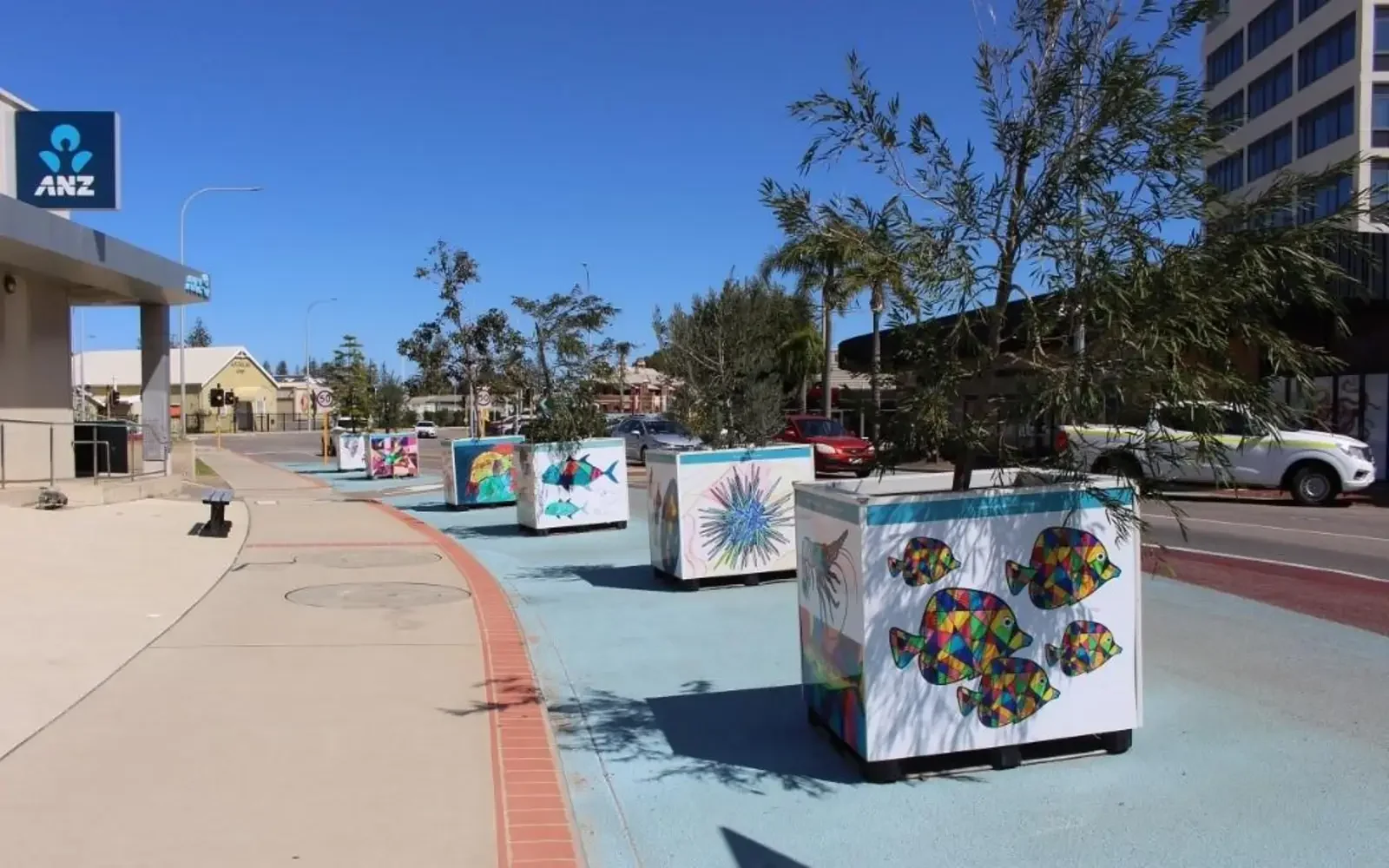
Fresh paint, new trees in planter boxes, a parklet and amazing local artwork unlocked a great deal of vibrancy on Chapman Road! Along with a significant art element, recycled planter boxes were installed featuring greenery, as well as RUOK benches donated by Desert Blue Connect. A favourite for the kids is the 'Critter Trail on Chapman' which takes youngsters on an interactive journey along Chapman Road to collect a secret password hidden amongst quirky art pieces.
Process
Concept design and plan: The proposed Stage 2 design was reviewed by Main Roads WA and the feedback received from Main Roads WA was that the proposed design could be trialled and the current 30km/h speedlimit retained as long as consideration was is given in the design to creating safe zones for occupants to exit or enter cars parked in parking bays.
Stage 2 of the Chapman Road Activation Trial has been informed by community feedback and the concept design reflects the revised road layout proposed in the Geraldton City Centre Revitalisation Plan.
What was changed?
- The two snaked traffic lanes will be straightened.
- Designated on-street parking will be created.
- Adjustments to the merging and demerging sections of the street will be made.
What remained the same?
- Testing of one lane of traffic in each direction.
- Retention of the 30km/h speed limit.
- 19 trees in colourful planter boxes.
- Artworks by local artists on buildings and windows.
- Interactive Critter Art Trail
Approvals
Councillors were informed through briefing notes and a concept forum presentation of the draft action plan.
Council endorsement of the Stage 2 design, Traffic and Risk Management Plan for the implementation or onground works to install the Stage 2 Design.

The project needed more community input and leadership to prevent community opposition. It was seen as government led and not community led which meant the original snaked traffic concept had to be reworked.
The reduction of the road width to one lane each way, as this section of Chapman Road does not meet the minimum road width requirement for it to be four lanes wide and a reduction on speed limit to 30km/h proved unpopular with drivers.
Merging of two traffic lanes to one in front of the Art Gallery as it caused some peak hour congestion. A right turn-only lane heading south on Chapman Road onto Durlacher Street was planned for this intersection but Main Roads WA approval was not possible with the available budget and time frame.
"A key priority of RAC's Reconnect WA initiative is to inspire local residents and businesses to get involved in driving positive change in their local areas. Pop-up bike lanes, wider footpaths, improved pedestrian crossings and new parklets are all in the mix to help this stretch of Chapman Road become a more attractive place for people, not just cars." Patrick Walker, RAC
A budget of "00,000 was required to undertake the redesign of the two-lane road to Main Roads WA approval omitting the snaked geometry, removal of the existing painted surfaces, reinstatement of a painted road alignment adding on-street parking to improve amenity and reduce traffic and to review the City of Greater Geraldton City Centre Revitalisation Plan.
The City had the required resources to undertake the design, procurement and delivery of the project. The installation works were outsourced to the City's annual supply contractors.